Most enterprises building multi-agent AI patterns are over-engineering. Gartner predicts over 40% of agentic AI projects will be canceled by 2027. McKinsey reports less than 10% of organizations have successfully scaled AI agents in any function. The patterns that work in production are simpler than the hype suggests.
We know this because Neomanex runs its own operations on enforced multi-agent workflows. The lesson: coordination topology matters more than agent count. Here is what actually works.
TL;DR
- 40%+ of agentic AI projects will be canceled by 2027 — most over-engineer before mastering fundamentals
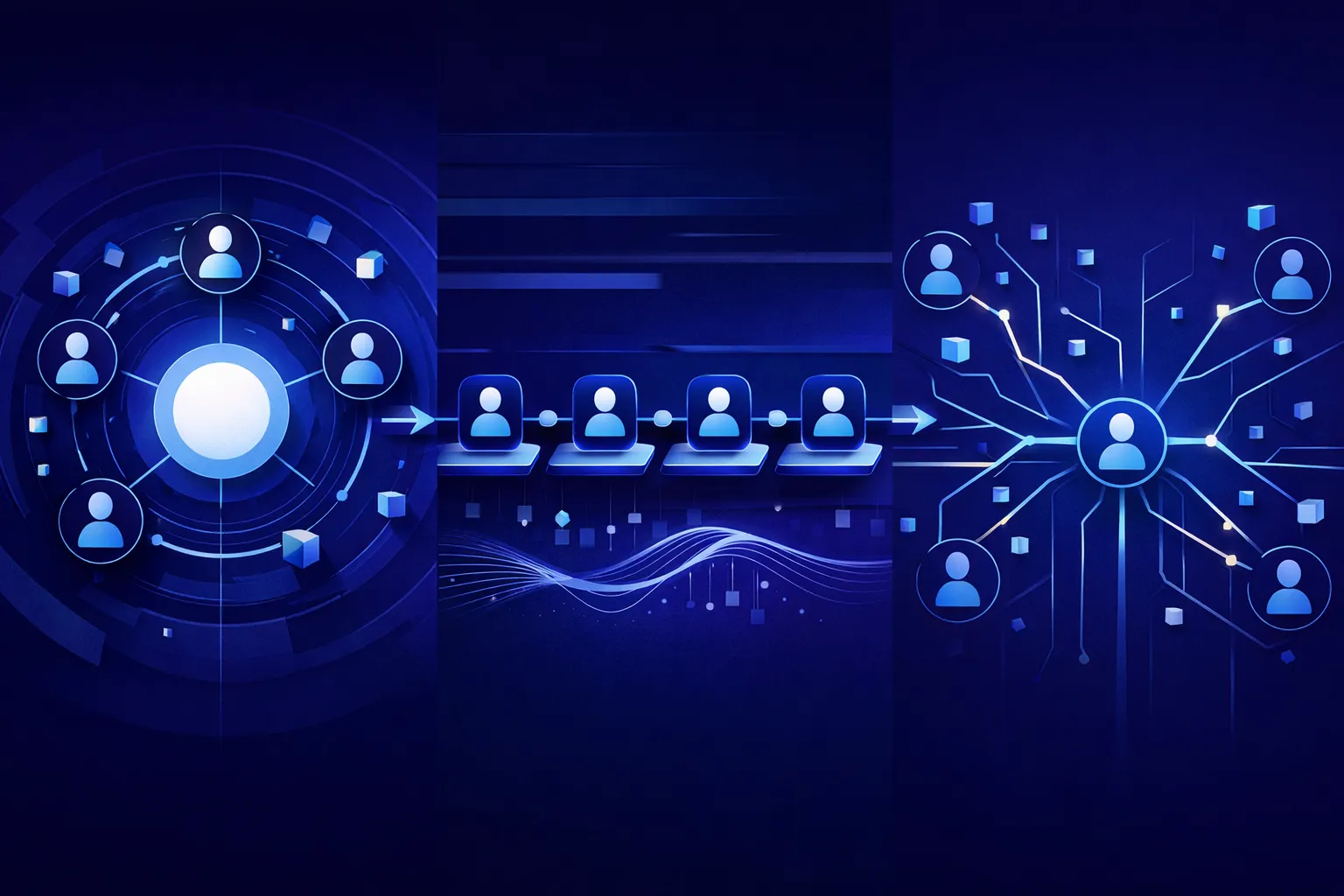
- Three patterns dominate production: Orchestrator-Worker, Sequential Pipeline, and Router
- The 17x error trap: chaining agents at 95% accuracy creates cascading failures, not 95% system accuracy
- Governance is the missing pattern — coordination without enforced workflows is expensive chaos
- Start with one orchestrator, not a swarm — the shift is from "how many agents" to "how well coordinated"
The Multi-Agent Trap — Why More Agents Is Not Better
Multi-agent AI inquiries surged 1,445% from Q1 2024 to Q2 2025. The market is projected to grow from $8.5B in 2026 to $45B by 2030. 80% of Fortune 500 companies now have active AI agents. The interest is real — and so is the risk of agent sprawl.
The results are not. Only 28% of enterprises have mature capabilities combining automation with AI agents. The rest are hitting what researchers call the "17x error trap": at 95% per-step accuracy, chaining agents without structured coordination degrades reliability by up to 17x through compound failure. The critical variable is the topology of coordination, not the number of agents.
Performance typically degrades beyond the four-agent threshold without structured topology. Multi-agent systems are, in many cases, a workaround for the limits of today's LLMs — and as base models improve, fewer tasks will need multiple agents at all. The enterprises that succeed do not chase autonomy for its own sake. They design for predictable collaboration between agents and humans.
Three Multi-Agent Orchestration Patterns That Work in Production
Google cataloged eight multi-agent design patterns in January 2026. Of those, three dominate enterprise production deployments. They share a common trait: centralized control, deterministic flow, and audit-friendly execution.
Orchestrator-Worker
A single manager agent coordinates tasks and data flow to specialized workers. This is the most adopted pattern in enterprise because it provides clear control, simplified management, and a single point of accountability.
Production proof: A major bank's agentic AI digital factory achieved over 50% reduction in development time using orchestrator-worker for legacy code modernization.
Sequential Pipeline
Agents arranged like an assembly line, each passing output to the next. Google describes this as "linear, deterministic, and refreshingly easy to debug." Ideal for document approval, compliance review, and content publishing workflows.
Why it wins: Determinism makes it the easiest pattern to govern and audit — which matters more than sophistication in regulated environments.
Router (Coordinator/Dispatcher)
One agent receives requests and dispatches to specialized agents. Enterprises adopt this for customer service (routing to domain experts) and IT operations (routing incidents to resolution agents).
Key insight: Intelligent dispatch, not parallel chaos. The router decides who handles what — it does not let every agent compete for every task.
These are not the most sophisticated patterns. They are the most governable ones. Reliability in multi-agent systems arises not from intelligent agents alone, but from the orchestration layer that governs planning, execution, and validation. For a deeper look at how these patterns fit into the broader multi-agent AI orchestration landscape, see our complete enterprise guide.
Neomanex runs its own operations on enforced multi-agent workflows.
Book a free Discovery Session to see how orchestrator-worker, sequential pipelines, and governance-first architecture work in production.
Governance Is the Missing AI Agent Orchestration Pattern
Most content about multi-agent coordination patterns focuses on how agents talk to each other. The real gap is how organizations govern those agents. Multi-agent without governance is multi-agent chaos. Workflow enforcement is the mechanism that turns coordination patterns into reliable operations.
Identity, permissions, auditability, reliability, change management — these get deferred until the pilot hits a wall. 80% of leaders believe their automation is mature, but only 28% actually have mature capabilities combining automation with AI agents. The gap is governance.
| Governance Pattern | What It Solves |
|---|---|
| Authority boundaries | Defines when agents act vs. escalate to humans |
| Role-based agent access | Treats agents as privileged users with identity management |
| Phased autonomy | Shadow mode, then assisted, then autonomous within boundaries |
| Policy-embedded execution | Governance built into orchestration, not bolted on |
| Decision audit logging | Complete trails capturing inputs, reasoning, and actions |
This is where the distinction between model governance and operational AI governance matters. Platforms like Credo AI and IBM watsonx.governance govern the AI itself — bias, fairness, explainability. But the real breakdown happens at the operations layer: enforced workflows, role-based access, standards that the system enforces rather than relying on individual discipline. Neomanex operates this way internally — enforced workflows, role-based AI access, company-wide standards — and implements the same AI Operating Model for clients. It is the control plane nobody talks about. For related reading on AI agent observability, see our enterprise monitoring guide.
What This Means for Enterprise Architects
Protocols like MCP (agent-to-tool) and A2A (agent-to-agent) are converging under Linux Foundation governance, with a joint interoperability spec expected by Q3 2026. But protocols are not the bottleneck. Governance and operational discipline are.
- Start with one orchestrator, not a swarm. The orchestrator-worker pattern gives you centralized control, single accountability, and a clear path to agent security compliance.
- Enforce standards before scaling agents. Adding a fifth agent to a system without governance creates five sources of uncoordinated output. Mature governance frameworks increase organizational confidence to deploy agents in higher-value scenarios.
- Shift from "how many agents" to "how well coordinated." Multi-agent DevOps systems with structured coordination achieve 100% actionable recommendation rates vs. 1.7% for single-agent approaches. The coordination topology is the differentiator, not the agent count.
The winning multi-agent system architecture is not the most autonomous one. It is the one where every agent operates within enforced boundaries, every decision is auditable, and the coordination layer — not individual agents — owns the reliability guarantee.
Related Reading
- Multi-Agent AI Orchestration: 5 Patterns That Deliver 90% Gains — Single agents plateau at 45%; multi-agent coordination delivers 90% gains across complex workflows.
- AI Agent Observability: Enterprise Monitoring Guide — 80% of Fortune 500 deploy agents; only 13% have visibility into what their agents actually do.
- AI Agent Use Cases: 25+ Enterprise Apps by Department — Identify which enterprise use cases benefit most from multi-agent coordination patterns.
- AI Workflow Enforcement: Why Optional AI Guidelines Fail — How enforced standards across coordinated agents prevent governance gaps.
Start With Governance, Not More Agents
If governing multi-agent AI operations feels overwhelming, start with a free Discovery Session. Neomanex can implement your AI Operating Model — enforced workflows, role-based access, company-wide standards — in weeks, not quarters. No commitment, just clarity on your multi-agent architecture.
Never need to catch up again
The weekly delta: only verdict changes and act-now items. No digest filler.