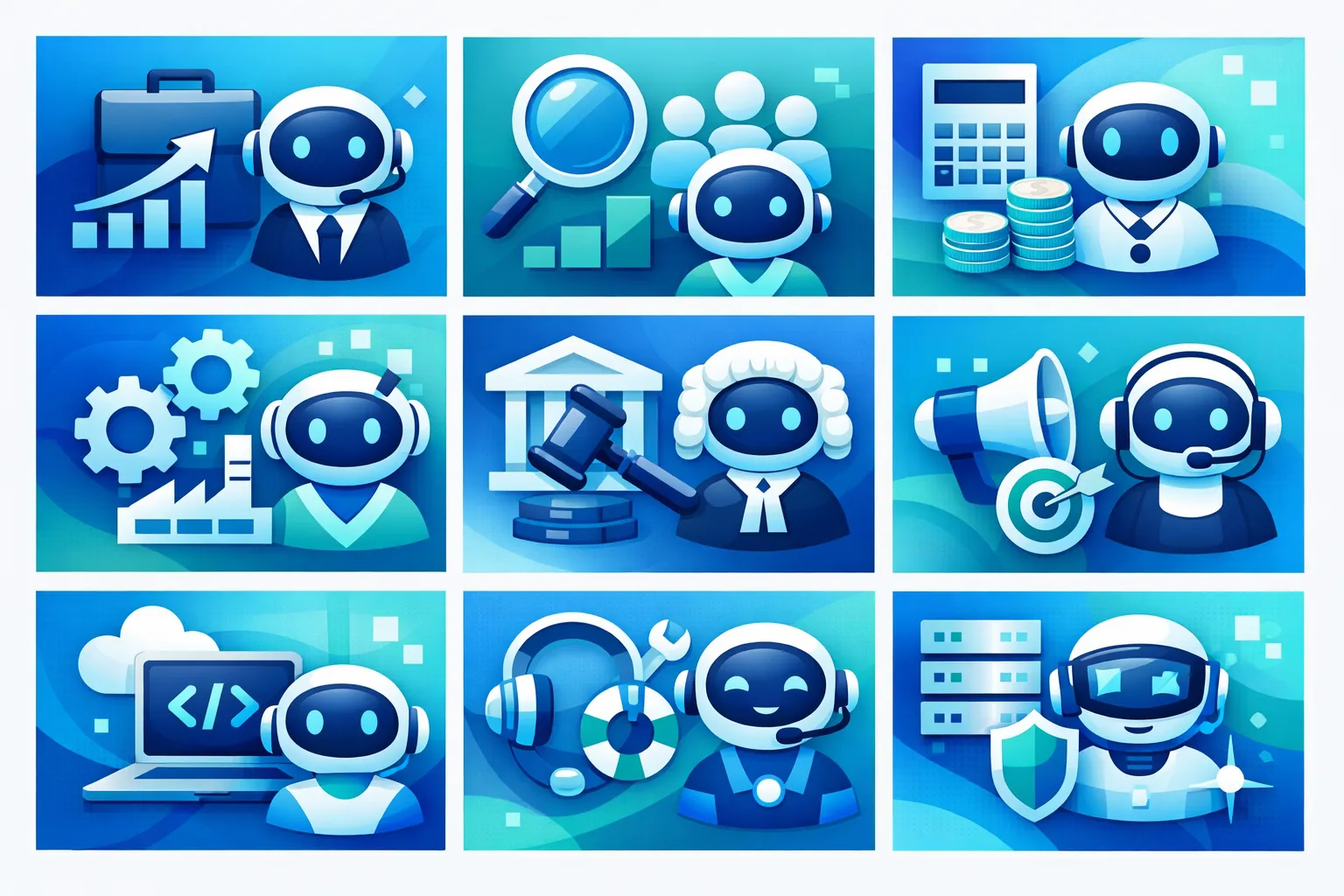
25+ AI agent use cases across eight enterprise departments — and customer support and IT operations deliver the fastest ROI. With 79% of senior executives reporting active AI agent adoption and 40% of enterprise apps expected to embed agents by end of 2026, the question is no longer whether to deploy but where to start. This department-by-department breakdown gives you the use cases, measurable outcomes, and governance requirements to prioritize deployment.
TL;DR
- Customer support and IT operations deliver fastest ROI — 1-3 month payback, 57% and 53% already deployed
- 66% report higher productivity, 57% report cost savings from AI agents
- 40%+ of agentic AI projects will fail without governance, observability, and ROI frameworks (Gartner)
- Start with one high-volume, low-complexity process per department — then scale
- Governance varies by department: HR and finance face highest regulatory scrutiny under EU AI Act
Table of Contents
- 1. Customer Support — Ticket Triage, Resolution, and Escalation
- 2. Sales — Lead Qualification and Pipeline Management
- 3. Marketing — Campaign Optimization and Personalization
- 4. Finance — Invoice Processing, Fraud Detection, Forecasting
- 5. Human Resources — Recruiting, Onboarding, Employee Support
- 6. IT Operations — Incident Response and Access Management
- 7. Supply Chain — Inventory, Logistics, and Procurement
- 8. Legal and Compliance — Contract Review and Regulatory Monitoring
- Where to Start — Prioritizing AI Agent Deployment
1. Customer Support — Ticket Triage, Resolution, and Escalation
Adoption: 57% of enterprises have deployed AI agents in customer support — the highest of any department. By 2028, 68% of customer interactions will be handled by autonomous tools.
| Use Case | Measurable Outcome |
|---|---|
| Ticket triage and auto-routing | 60-80% reduction in ticket handling time |
| Autonomous resolution of routine requests | Klarna AI resolves errands in under 2 min vs 11 min for humans |
| Sentiment analysis and escalation | Delta Airlines: 12% satisfaction increase, 10% complaint reduction |
| Predictive churn analysis | Identifies at-risk customers and triggers recovery workflows |
For businesses starting with conversational AI, our guide to AI chatbots for business covers the foundation. Customer support agents work best when they handle the high-volume, low-complexity tickets that consume 80% of your team's time — freeing humans for complex escalations. The key distinction from traditional automation is that AI agents vs RPA comes down to adaptability: agents handle unstructured queries that rule-based systems cannot.
2. Sales — Lead Qualification and Pipeline Management
Adoption: 54%. SDR agents operate 4x faster than manual processes, and McKinsey reports 10-20% sales ROI boosts from AI agent deployment.
| Use Case | Measurable Outcome |
|---|---|
| Lead qualification and scoring | CRM-integrated scoring using engagement data |
| Deal forecasting and pipeline prioritization | Predicts closing likelihood, prioritizes high-value deals |
| Real-time sales coaching | In-moment guidance during calls with auto-generated summaries |
Sales agents differ from AI copilots in a critical way: agents execute autonomously (qualifying leads, updating CRM records, triggering follow-ups), while copilots only suggest actions for humans to approve.
3. Marketing — Campaign Optimization and Personalization
Adoption: 54%. Marketing teams report up to 37% cost savings from AI agent deployment, with a 10x increase in data-driven decisions when using natural language agents vs traditional BI tools.
| Use Case | Measurable Outcome |
|---|---|
| Campaign optimization (A/B testing, budget allocation) | Auto-shifts budget to high performers, pauses underperformers |
| Precision targeting and personalization | Behavioral pattern-based content delivery at scale |
| Content automation | Scale output without proportional headcount increase |
Deploying agents across multiple departments without centralized governance creates AI chaos.
Neomanex implements your AI Operating Model — role-based access, enforced workflows, and company-wide standards — in weeks, not quarters.
4. Finance — Invoice Processing, Fraud Detection, and Forecasting
Adoption: 34%. JPMorgan Chase saved 360,000 hours of manual work annually. Finance agents face the highest compliance requirements — SOX auditability and regulatory monitoring are non-negotiable.
| Use Case | Measurable Outcome |
|---|---|
| Invoice processing and AP automation | 70-90% reduction in processing time |
| Real-time fraud detection | Clears 100K+ alerts in seconds vs 30-90 min per alert manually |
| Predictive financial forecasting | Scenario-based forecasts using live market data |
| Contract leakage detection | One company identified 4% of total spend as leakage |
5. Human Resources — Recruiting, Onboarding, and Employee Support
Adoption: 40%. AI agents for HR deliver measurable recruiting gains — 31% hiring cost reduction and 50% faster time-to-hire — but carry the highest regulatory risk. Employment decisions are classified as "high-risk" under the EU AI Act, requiring conformity assessments and human oversight.
| Use Case | Measurable Outcome |
|---|---|
| Resume screening and candidate ranking | 31% hiring cost reduction, 67% improved hire success rate |
| Employee self-service (HR queries) | IBM AskHR automates 80+ common HR requests |
| Employee onboarding automation | 65% of businesses with AI onboarding report major gains |
Unilever saves over $1M annually in recruiting costs. But deploying AI agents for HR without governance — bias auditing, decision transparency, human override capability — is a compliance liability. For more on building these guardrails, see AI agent security frameworks.
6. IT Operations — Incident Response and Access Management
Adoption: 53%. AI agents for IT operations deliver some of the most dramatic efficiency gains in the enterprise — 4-6x faster incident response and massive alert noise reduction.
| Use Case | Measurable Outcome |
|---|---|
| Automated incident triage and routing | Filtered 74,826 of 75,000 alerts, escalating only 174 |
| Incident response automation | 52% reduction in response times |
| Anomaly detection and system monitoring | 47% visibility increase across multi-vendor stacks |
| Case clustering for major incidents | Consolidates related tickets, eliminates duplicate effort |
IT operations is where multi-agent orchestration shows its value. Incident triage agents hand off to resolution agents, which coordinate with monitoring agents — each operating within enforced boundaries. This is the pattern that scales: agents with defined roles, governed workflows, and clear escalation paths.
7. Supply Chain — Inventory, Logistics, and Procurement
Adoption: 23%. Lowest among core departments but growing fast — 62% of organizations are experimenting with agentic supply chain systems. AI-enabled supply chains show 67% better risk reduction.
| Use Case | Measurable Outcome |
|---|---|
| Demand forecasting | 20-50% reduction in forecasting errors |
| Inventory optimization | 35% inventory reduction, 65% increase in service levels |
| Route optimization and delivery | 18% delivery time reduction, $200K+ annual savings |
| Predictive maintenance | 30-40% reduction in unplanned downtime |
8. Legal and Compliance — Contract Review and Regulatory Monitoring
Adoption: 18% — the lowest of all departments, but with the highest per-task time savings. Legal teams achieve full ROI within 6-12 months. For details on enterprise AI compliance requirements, see our dedicated guide.
| Use Case | Measurable Outcome |
|---|---|
| Contract review and analysis | Up to 90% reduction in review time; 3-4x more volume handled |
| Regulatory monitoring | Auto-flags potential violations across evolving regulations |
| Risk assessment | Predicts regulatory change impact on existing contracts |
Where to Start — Prioritizing AI Agent Deployment by Department
62% of organizations lack a clear starting point for AI agent implementation. Use this priority framework based on deployment maturity, ROI timeline, and compliance risk.
| Priority | Department | Risk Level | ROI Timeline |
|---|---|---|---|
| 1 | Customer Support | Low | 1-3 months |
| 2 | IT Operations | Low-Medium | 1-3 months |
| 3 | Sales | Medium | 2-4 months |
| 4 | Marketing | Medium | 2-4 months |
| 5 | HR | Medium-High | 3-6 months |
| 6 | Finance | High | 3-6 months |
| 7 | Supply Chain | Medium-High | 4-8 months |
| 8 | Legal/Compliance | High | 6-12 months |
The pattern that works: start with one high-volume, low-complexity process — the kind of busywork teams will be relieved to delegate. Pilot with 5% of traffic, measure real business impact, then expand. Deploy department-by-department to reduce disruption and enable focused support. Before scaling, evaluate whether to build or buy your AI agents — the answer varies by department and use case complexity.
The critical gap most companies miss: 92% believe governance is essential, but only 44% have policies in place. Gartner predicts 40%+ of agentic AI projects will be scrapped by 2027 without governance and observability. Each department has different compliance requirements — GDPR for customer-facing agents, SOX for finance, EU AI Act high-risk classification for HR. An AI Operating Model that standardizes governance across departments is how you avoid the "AI chaos" that stalls most enterprise rollouts. For the full enterprise roadmap, see our guide to enterprise AI adoption from pilot to production. If you want to implement AI in your business beyond pilots, centralized governance is the prerequisite.
Frequently Asked Questions
What are the best AI agent use cases for enterprise deployment?
Customer support (57% adoption) and IT operations (53%) deliver the fastest ROI with 1-3 month payback periods. Support agents handle ticket triage, routine resolution, and sentiment-based escalation. IT operations agents automate incident response, anomaly detection, and case clustering. Sales (54%), marketing (54%), HR (40%), finance (34%), supply chain (23%), and legal (18%) follow with progressively longer ROI timelines but significant departmental gains.
Which department should deploy AI agents first?
Start with customer support or IT operations — the departments with highest existing adoption, lowest compliance risk, and fastest ROI (1-3 months). Pick one high-volume, low-complexity process per department: ticket triage for support, alert filtering for IT. Pilot with 5% of traffic, measure business impact, then expand. This approach builds organizational confidence and governance infrastructure before tackling higher-risk departments like HR or finance.
How do you measure ROI from AI agent use cases?
Track business metrics, not adoption metrics. For each use case, measure before-and-after: ticket handling time (customer support), lead conversion rate (sales), campaign cost per lead (marketing), invoice processing time (finance), time-to-hire (HR), incident MTTR (IT operations). Establish baselines before deployment, compare at 30/60/90 days. 66% of enterprises report higher productivity, 57% report cost savings.
What governance is required for AI agent use cases across departments?
Governance requirements vary by department risk level. Customer support and IT operations need baseline governance: role-based access, audit logging, and workflow enforcement. HR and finance face the highest compliance scrutiny — HR employment decisions are classified as high-risk under the EU AI Act, requiring conformity assessments and mandatory human oversight. 92% of enterprises believe governance is essential, but only 44% have policies in place. Gartner predicts 40%+ of agentic AI projects will be canceled by 2027 without governance frameworks.
Related Reading
- AI Agents vs RPA: Why Intelligent Automation Changes Everything — Compare AI agents and RPA across 7 key dimensions and see when each technology delivers the best ROI.
- Multi-Agent AI Systems: The Enterprise Orchestration Guide — Learn how specialized agents coordinate for complex enterprise workflows.
- AI Agents vs AI Copilots: Key Differences — Understand the distinction between autonomous agents and assistive copilots, and when each fits.
- Enterprise AI Adoption: From Pilot to Production in 2026 — The 4-phase roadmap for moving AI use cases from experiment to enterprise-wide rollout.
- Build vs Buy AI Agents: Enterprise Decision Framework 2026 — When to build custom, when to buy, and how to evaluate the TCO of AI agent deployment.
Map AI Agent Use Cases to Your Departments
Start with a free Discovery Session. We will identify the highest-ROI AI agent use cases for your specific departments and design the governance framework to deploy them safely — in weeks, not quarters.
Never need to catch up again
The weekly delta: only verdict changes and act-now items. No digest filler.